2025 was a breakout year for AI in my workflow. I started using AI for coding assistance in 2024, but by 2025 it was no longer just generating snippets. It began shaping architecture decisions, accelerating execution, and helping move real projects forward.
That shift naturally leads to a broader question: what does AI mean for SaaS products in 2026?
Below are my perspectives as a founder building and using SaaS every day.
From answers to actions
AI in SaaS started the same way AI in coding did. You ask a question and get an answer. Early copilots focused on explanations, suggestions, and surface-level assistance.
Coding tools did not stop there. They evolved into systems that draft code, wire components together, generate tests, open pull requests, and iterate alongside developers. SaaS is following the same trajectory.
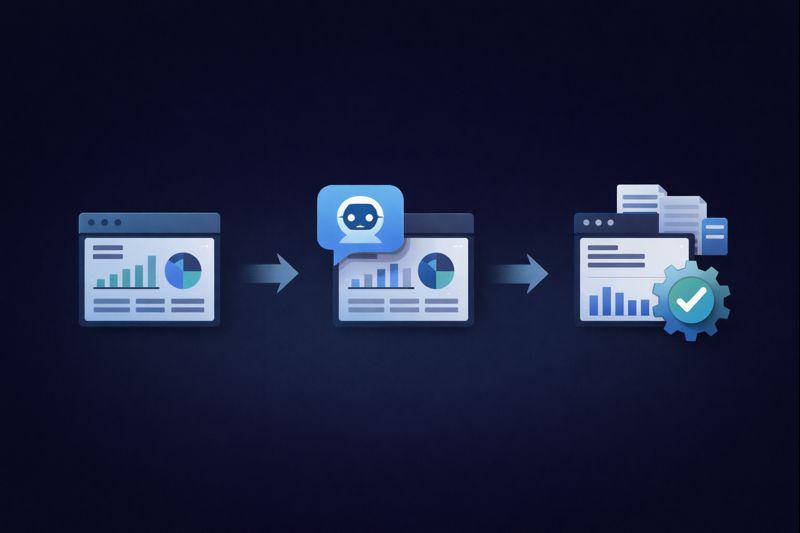
In 2026, the most valuable AI copilots will not simply explain how to use a product. They will take action on behalf of the user, guided by intent and constrained by clear controls.
Consider a digital marketer who wants to compare mobile versus desktop performance for a Boxing Day campaign. Today, this usually means navigating multiple reports, applying filters, selecting segments, and exporting charts. Instead, the user should be able to say:
“Compare mobile vs desktop performance for Boxing Day. Explain what changed and why.”
The agent builds the report, applies the correct filters, pulls the relevant data, and summarizes the outcome.
This direction is already visible in the market. Gartner predicts that 40 percent of enterprise applications will include task-specific AI agents by 2026, up from single-digit adoption today. Leading developer tools show that moving from suggestion to execution dramatically increases daily usage and stickiness. The shift is not about novelty. It is about reducing time-to-outcome.
Trust and approval become the real bottleneck
As AI agents gain the ability to act, trust becomes the central product challenge. Users will want to understand what the agent is doing, why it is doing it, what data it used, and which actions require approval.
From a product standpoint, fully opaque agents will struggle to gain adoption in serious B2B software. This is not only a UX concern. Governance and regulation are already reinforcing this expectation.
The NIST AI Risk Management Framework emphasizes transparency, explainability, and human oversight as core principles for trustworthy AI. Regulatory efforts such as the EU AI Act further highlight the importance of human oversight for systems that can materially affect outcomes.
In practice, the winning pattern will look less like a generic chat window and more like an embedded copilot. One that operates inside the product UI, shows intermediate steps, previews changes, and asks for confirmation when the stakes are high. Trust will be earned through visibility.
Personalization is how agents become genuinely useful
An agent that treats every user the same will feel shallow very quickly. In B2B SaaS especially, usefulness depends on context.
That context includes company goals and KPIs, the user’s role and seniority, permissions and risk tolerance, and preferred level of detail. A CFO and a marketing analyst can look at the same dataset and expect entirely different assistance. One wants summarized impact. The other wants drill-downs and anomalies.
Agents only begin to feel intelligent when they adapt to the person, not just the data. This is less about model capability and more about thoughtful product design.
Why AI agents in SaaS become non-optional
The strongest case for agents is not hype. It is productivity.
When AI is embedded directly into workflows, the gains are measurable. GitHub has reported that developers using Copilot completed certain tasks roughly 55 percent faster in controlled experiments. In a real customer support environment, a well-cited field study found approximately 14 percent higher productivity, with even larger gains among less experienced workers. Research in consulting and knowledge work shows similar patterns, while also highlighting that poor integration can reduce quality.
Translated into SaaS terms, this has several practical implications.
- A lower learning curve leads to higher adoption. Instead of reading documentation or booking training sessions, users can ask an agent to perform tasks while observing how they are done. Value is delivered immediately, and learning happens implicitly.
- Support costs also shift. When agents handle routine tasks such as generating reports, locating invoices, or configuring dashboards, support teams can focus on complex and strategic issues that drive retention and expansion.
- Ultimately, speed becomes the differentiator. SaaS exists to help users get jobs done. Products that minimize friction and compress time-to-outcome will consistently outperform those that rely on manual navigation and configuration. By 2026, software that requires extensive clicking for workflows will feel dated.
The tools layer matters more than the model
The effectiveness of AI agents depends less on model size and more on the tools and context they can safely access. A powerful model without the right tools behaves like a smart assistant without hands or memory. It can explain, but it cannot reliably help users get work done.
Three elements stand out as foundational.
- UI-driven actions The first is UI-driven action. The agent operates the product interface the way an experienced user would, opening reports, applying filters, configuring settings, and building dashboards in full view of the user. This approach has two benefits. It makes actions transparent, and it aligns the agent’s behavior with how the product is actually meant to be used. For sensitive operations, the agent can prepare everything while leaving the final confirmation to the user.
- API-driven execution The second is API-driven execution. For scale, performance, and reliability, agents need structured APIs and tool interfaces rather than brittle UI automation alone. This layer is where permissions, validation rules, and audit logging live. Well-designed APIs allow agents to act confidently while staying within clearly defined boundaries.
- Product knowledge as first-class input For an AI agent to be genuinely useful, it must behave like an expert user of the SaaS product it supports. That requires access to the product’s knowledge base, not just raw data or APIs. This includes documentation, feature explanations, best practices, limitations, and common workflows. Without this context, an agent may technically be able to take actions, but it will struggle to choose the right ones or sequence them correctly to solve real-world problems. In practice, this means agents should be guided by the same institutional knowledge that experienced human users rely on. When a user asks how to solve a problem, the agent should not only execute steps but also understand which features are appropriate, which trade-offs exist, and which approach aligns with the product’s intended usage. Treating the knowledge base as a first-class input allows agents to move beyond mechanical execution and toward informed decision-making.
- Guardrails by design Finally, agents must be paired with strong guardrails. If agents are expected to act, they need role-based permissions, previews before changes are applied, detailed action logs, reversible operations, and escalation paths when confidence is low. These controls do not slow agents down. They make adoption possible. Without them, increased capability quickly turns into increased risk.
Every SaaS becomes an AI business
AI feels similar to earlier waves of digital transformation. At first, it is a differentiator. Then it becomes table stakes.
In my view, AI will follow the same path. By 2026, it will no longer be framed as a feature or an add-on. It will be part of the core value proposition of every serious SaaS product.
User expectations are shifting away from features and toward outcomes. Agents are the most direct way to bridge that gap.
How are you thinking about introducing AI to your SaaS users?